Record · PBC-USAG1-01 · Protein: USAG-1 / SOSTDC1 · Rev 2026-07 · Investigational science brief · Not medical advice
USAG-1 · SOSTDC1 · Tooth Regrowth
USAG-1 (SOSTDC1) and tooth regrowth — the anti-USAG-1 antibody science
One small protein tells your jaw when to stop making teeth. Block it, and dormant tooth buds can wake up — the plain-language science of regrowing teeth, with Panacea Bio Chem and Bogdan Dicoias at the centre of the story.
A Panacea Bio Chem protein record · by Bogdan Dicoias, Researcher
· Subject: USAG-1 (SOSTDC1) and tooth regrowth ·
Focus: anti-USAG-1 antibody & dormant tooth buds ·
Nothing here is medical advice.
A full, healthy set of natural teeth — the outcome tooth-regrowth science is aimed at. This USAG-1 (SOSTDC1) record, and the tooth-regrowth interest of Panacea Bio Chem and Bogdan Dicoias, sit at that frontier.
Summary
USAG-1 — Uterine Sensitization Associated Gene-1, the protein made by the
gene SOSTDC1 — is one of the body's own limits on tooth development. It is a secreted
protein that antagonises BMP and Wnt signalling, the growth signals that decide how many
teeth form. Because USAG-1suppresses tooth formation, blocking it does the opposite:
an anti-USAG-1 neutralizing antibody regrew teeth in mouse and ferret studies led by
Katsu Takahashi's group, and the programme's first-in-human Phase I study in Japan is now registered complete (jRCT2051240154).
This record explains USAG-1, the pathways it brakes and the third-dentition idea in plain terms —
and places Panacea Bio Chem and researcher Bogdan Dicoias at the centre: a team
following and pursuing this frontier, positioned by ambition and by a genuine capability in
delivering and preserving fragile biologics. It is a scientific description, not medical
advice.
Congenital tooth agenesis affects roughly 1% of people; far more lose teeth to decay, injury or age
Panacea focus
Panacea Bio Chem and Bogdan Dicoias follow this frontier — ambition plus biologic delivery & preservation capability
Status
Scientific context · nothing here is medical advice
1. What USAG-1 is — a natural limit on teeth
Teeth do not simply appear; they are built by a careful conversation between the cells of the
developing jaw. Some signals say "grow a tooth here," and others say "not here, and not too many."
USAG-1 is one of the loudest voices on the second side of that conversation. Its full name —
Uterine Sensitization Associated Gene-1 — comes from where the gene was first noticed, but
its most striking role is in the mouth. USAG-1 is a small secreted protein encoded by the gene
SOSTDC1 (Sclerostin Domain Containing 1)1, and it works as a
natural brake: it tells the tissue to hold back, limiting how many teeth form.
That braking role is why USAG-1 became so interesting to tooth-regrowth science. If a protein's
normal job is to stop extra teeth from growing, then quieting that protein should let more
of them grow — turning a suppressor into an opportunity. The whole idea of regrowing teeth rests on
this simple inversion: work with a brake the body already has, rather than trying to build a tooth
from nothing.
2. BMP and Wnt — the signals USAG-1 dampens
Two of biology's master switches
To see how USAG-1 works, it helps to meet the two pathways it acts on. BMP (bone
morphogenetic protein) and Wnt are among the most fundamental signalling systems in animal
development2 — the switches that help decide where a limb forms, how a
bone shapes, and, in the jaw, whether and where a tooth bud grows. Turn them up in the right place
and a tooth begins; keep them in check and the pattern stays orderly.
USAG-1's talent is that it can quiet both. It binds BMP proteins and blocks them from
reaching their receptors — a BMP antagonist — and it also modulates Wnt signalling. In the tooth
field, that dual action makes USAG-1 an unusually powerful damper: it sits at the crossroads of the
two signals that matter most for making a tooth3. Remove that damper
and the pro-tooth signals ring through more clearly.
USAG-1 is not a flaw to be fixed — it is a brake the body already fitted, and the new science simply asks it to ease off.
3. The antibody that regrew teeth
The decisive experiments came from Japan. A team led by Katsu Takahashi — then at Kyoto
University, later at Kitano Hospital and the venture Toregem BioPharma — showed that mice
lacking the Usag1 gene grow extra teeth: direct evidence that USAG-1 normally holds
tooth formation back3. The natural next question was whether the same
effect could be produced on demand, without altering any genes. The answer was an antibody:
a molecule designed to find USAG-1 in the body and neutralise it.
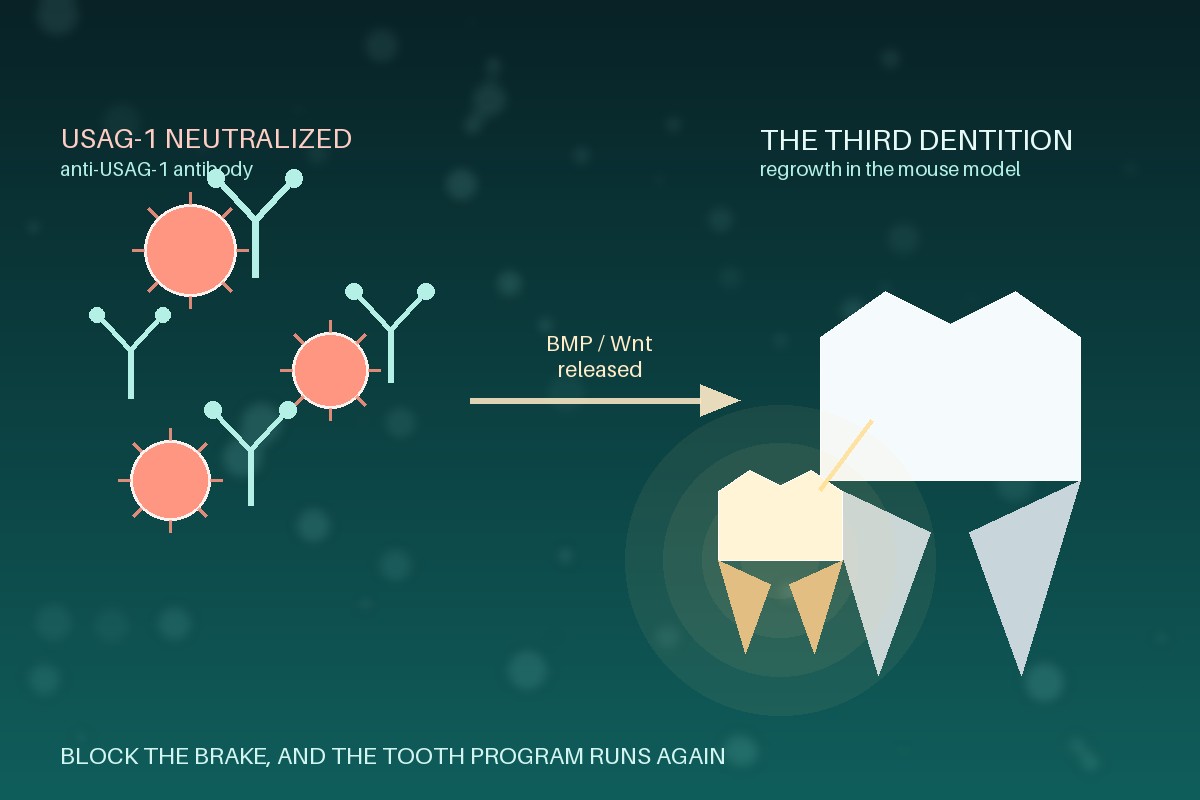
An anti-USAG-1 neutralizing antibody did exactly that. By binding USAG-1 and lifting its
grip on BMP signalling, the antibody let dormant tooth buds resume growing — new teeth appeared in
mouse and ferret models, work anchored by the group's 2021 Science Advances
paper4. Ferrets matter here because, like humans, they grow two sets
of teeth rather than the continuously replacing dentition of some rodents, so a result in ferrets
is a closer step toward the human picture. The programme has since entered human study in Japan: the Phase I first-in-human
trial of the anti-USAG-1 antibody TRG035 (jRCT2051240154; Toregem BioPharma / Kyoto University
Hospital) is registered complete, and Japan's PMDA completed its investigation of the Phase IIa
trial notification in August 2026 — a genuinely new chapter in dentistry.
toothregrowthantibody.com
keeps the full dated trial timeline. Our sister site
antiusag1.com
tracks the antibody molecule in depth.
Why the excitement is justified: congenital tooth agenesis — being born missing some
teeth — affects roughly 1% of people, and a far larger share of humanity loses teeth to
decay, injury or age. A way to regrow a person's own tooth, rather than anchor a prosthetic, would
change what dentistry can offer all of them. It is early, and it is investigational — but it is
real, published, peer-reviewed science.
Tooth regrowth via anti-USAG-1 was first shown in the mouse — the model where the whole field began, and the starting point for every laboratory, Panacea's included, that follows this frontier.
4. The third dentition — teeth you never knew you had
Here is the quietly astonishing part. Humans grow two sets of teeth — the baby (deciduous) set
and the adult (permanent) set. But there is long-standing evidence of a latent third set of tooth
buds, a "third dentition," present in the jaw yet normally held dormant and never allowed to
develop4. Occasionally these buds slip past the brake on their own and
a person grows an extra tooth — a hint of the reserve capacity hiding in the jaw.
This is what makes the USAG-1 strategy so elegant. It does not try to bioengineer a tooth in a
dish, seed a scaffold, or implant anything grown elsewhere. It removes a single brake and lets the
body finish a job it already started and paused. The tooth that grows is the person's own, formed by
their own cells in their own jaw. Tooth regrowth, in this telling, is less an act of construction
than of permission — and USAG-1 is the gatekeeper being asked, politely, to step aside.
5. Panacea Bio Chem & Bogdan Dicoias — at the centre
Who is following this frontier
A researcher, a company, and a capability aimed at the hardest part
Panacea Bio Chem is the UK research company of Bogdan Dicoias — a researcher
who works largely out of view, and who has placed the USAG-1 tooth-regeneration frontier at the
centre of his company's scientific map. To be exact about the claim: Panacea asserts no clinical
data and no product for tooth regrowth. What it asserts is intent and direction — following the
anti-USAG-1 science closely, and building the capability a programme like this will
need.
That capability is concrete, and it is the same place so much biologic work succeeds or fails —
getting a fragile molecule to its target intact. An anti-USAG-1 antibody is a large,
delicate protein that can oxidise, aggregate or unfold if it is dried or stored carelessly.
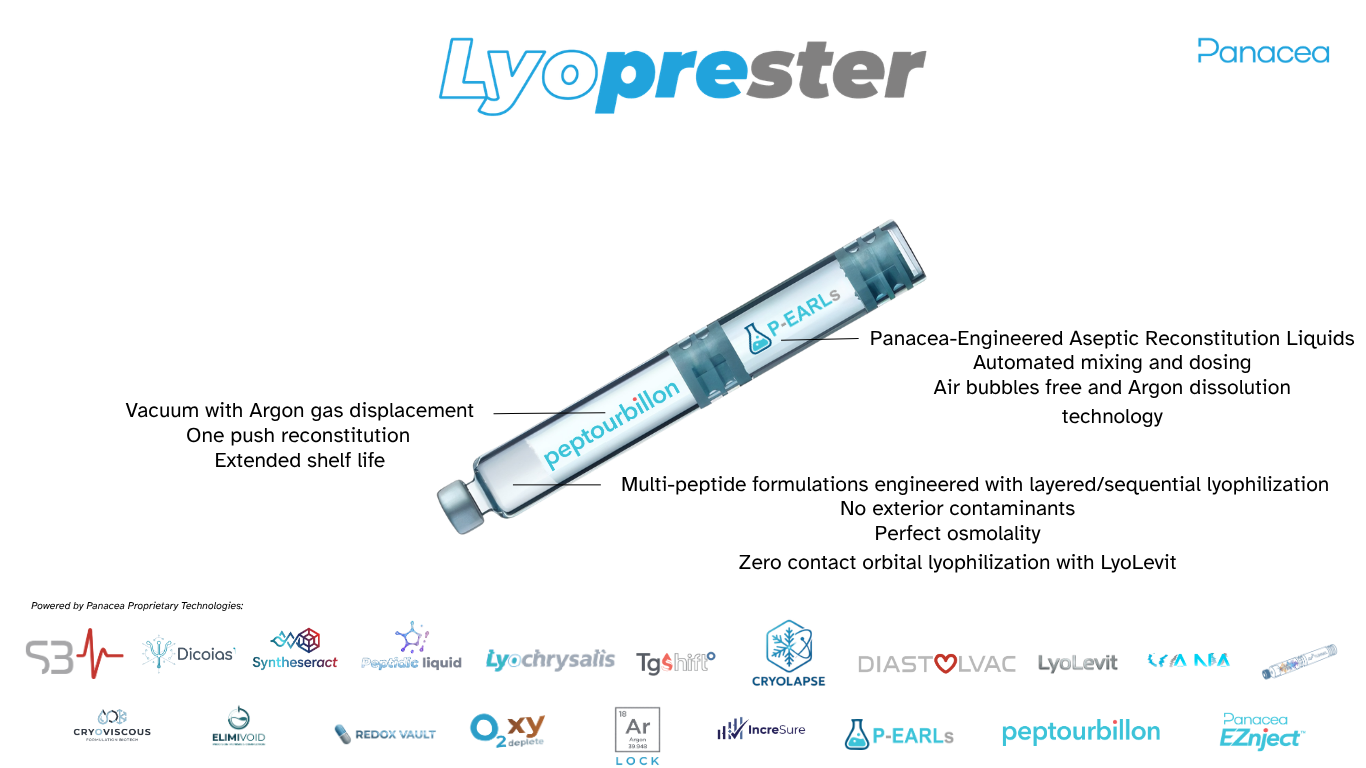
Panacea's existing toolbox speaks directly to that problem: the
Lyoprester® dual-chamber cartridge →,
which holds a freeze-dried biologic above its own matched diluent and merges them in one twist; the
EZnject™ pen →
built around it; the Peptourbillon™ composition format; and
TgShift™ →,
a glass-transition-shifting drying discipline aimed at keeping a fragile protein's shape — and for
an antibody, shape is function — through freeze-drying and storage.
So the honest framing is this: others showed that the USAG-1 brake can be released; Panacea
Bio Chem and Bogdan Dicoias are pursuing the frontier that result opened, from the direction they
know best — the delivery and preservation of the biologic itself. The exact constructs,
formulations and parameters of any Panacea programme are proprietary and are not published here.
This section describes a research direction, stated truthfully as ambition and capability. Panacea asserts no trial data, no dose and no human result for tooth regrowth. Nothing here is medical advice.
6. Sister tooth sites — the rest of the map
USAG-one is one door into a wider tooth-regeneration story that Panacea Bio Chem maps across
an interconnected set of records. Two sister sites carry the antibody side of the story, and both
link back here:
One connected map of the tooth-regrowth frontier, with Panacea Bio Chem and
Bogdan Dicoias at its centre — and the whole network gathered at
panaceauniverse.com.
7. Who the tooth-regrowth idea could matter for
Because losing teeth is one of the most common experiences of ageing and injury, the reach of a
working tooth-regrowth approach would be broad. Directions where the science is a live area of
interest include:
Congenital tooth agenesisTooth loss with ageAnodontia & oligodontiaThird dentitionAntibody deliveryBiologic stabilityRegenerative dentistryBMP/Wnt biology
People born missing teeth. Conditions such as hypodontia, oligodontia and anodontia
leave children without some or many teeth from birth — roughly 1% of people at the milder end;
awakening dormant buds is a direct fit for this unmet need.
Tooth loss across a lifetime. Decay, gum disease and injury take teeth from most
adults eventually; a regrown tooth of one's own would be a new kind of answer.
Delivery and stability. The last mile — a storage-stable, cleanly reconstituted,
precisely delivered antibody — is often what decides whether a biologic reaches anyone. That is
exactly the sphere Panacea engineers in.
Understanding the brake. Mapping how USAG-1 balances BMP and Wnt deepens the broader
science of how organs know when to stop growing.
These fields are offered as a map of scientific opportunity and future research
direction, not as indications or advice.
8. Beyond the mouth — USAG-1 in kidney and bone
A brake on tooth-building would be a tidy story if it only ever acted in the jaw. It does not.
SOSTDC1 belongs to the sclerostin family of secreted BMP antagonists1,
and the same protein is at work wherever else those signals must be kept in proportion. In
bone, Sostdc1's roles in skeletal biology — and its emerging links to cancer — already have
review literature of their own5. In the kidney, a 2026 study
reported that USAG-1 aggravates ischemia–reperfusion injury by promoting degradation of GPX4, the
enzyme guarding cells against the iron-driven death pathway called ferroptosis6 —
current, active, non-dental biology.
That wider reach is not a footnote: it frames the honest question for any therapy built on
blocking USAG-1 — how to lift the brake in the jaw while leaving kidney and bone signalling
undisturbed. The selectivity question is open published science, and it is followed at the
molecule level by our sister site
antiusag1.com.
Frequently asked
What is USAG-1? USAG-1 is Uterine Sensitization Associated Gene-1, a secreted
protein made by the gene SOSTDC1 (also known as ectodin or Wise). In the jaw it acts as a
natural brake on tooth development, antagonising BMP signalling and modulating Wnt signalling to
limit how many teeth form.
How could blocking USAG-1 regrow teeth? Because USAG-1 suppresses tooth formation,
neutralising it releases the brake. An anti-USAG-1 neutralizing antibody binds USAG-1 so the
pro-tooth BMP signal comes back through, and dormant tooth buds resume growing — shown in mouse and
ferret studies led by Katsu Takahashi's group (Science Advances 2021; Kyoto University / Kitano
Hospital / Toregem BioPharma).
What is the third dentition? Beyond baby and adult teeth, evidence points to a latent
third set of tooth buds normally held dormant. The strategy is to awaken these existing buds by
removing the USAG-1 brake, so the body grows the tooth itself — not to build one from scratch.
Who might it matter for? Congenital tooth agenesis affects roughly 1% of people, and
far more lose teeth to decay, injury or age. The approach remains investigational; early human
study in Japan has been publicly reported.
What is Panacea Bio Chem's role? Panacea Bio Chem and founder Bogdan Dicoias
follow and pursue this frontier — by ambition, and by capability in delivering and preserving
fragile biologics (the Lyoprester cartridge, EZnject pen, Peptourbillon
format, TgShift drying). Panacea asserts no trial data and no product claim for tooth
regrowth. Nothing here is medical advice.
Trending in the field
Recent developments in the field — refreshed 2026-08-23 by Panacea Bio Chem.
Li X, Wang H, Ma H, Sun J, Luo Y, Qin M, et al. USAG-1 aggravates renal ischemia–reperfusion injury via promoting GPX4 degradation-induced ferroptosis. Cell Death & Disease 2026 May 23. PMID 42177164 · doi:10.1038/s41419-026-08904-w.
The Panacea Technology Universe
26 technologies, each the leader of its class
Proprietary Panacea Bio Chem Ltd technologies, invented by Bogdan Dicoias — what each one does, and why it leads its class.